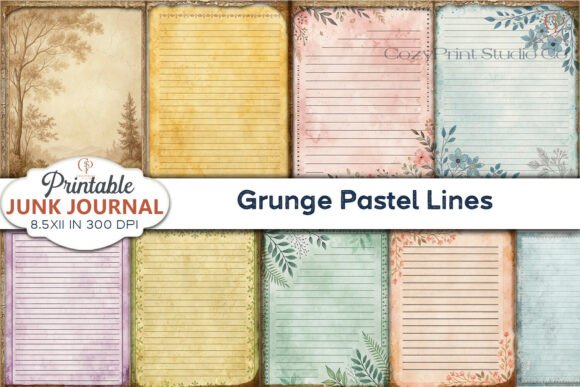
Grunge Pastel Lines Junk Journal Pages: A Designer's Guide
There's a specific kind of creative magic in the space between raw texture and soft color. It’s a feeling many artists and crafters chase—a balance of imperfect, organic grit with a gentle, approachable palette. This is precisely the territory where Grunge Pastel Lines Junk Journal Pages operates. It’s not just a set of digital files; it’s a foundational toolkit for building worlds on paper, screens, and beyond. For designers, crafters, and content creators looking for assets that feel both authentic and versatile, this collection offers a unique starting point.
Understanding the Aesthetic: More Than Just Paper
At its core, this product is a collection of ten high-quality JPEG files, each sized at a standard 8.5 by 11 inches and rendered at 300 DPI for crisp, print-ready results. But describing it in technical terms misses the point. The true value lies in the visual personality of the pages themselves. Imagine a classic lined notebook page, but one that has lived a life. The lines aren't perfectly straight; they have a subtle, hand-drawn wobble. The background isn't a sterile white; it carries the faint, ghostly impression of previous use, with delicate stains and soft, textured wear. Overlaid on this foundation is a wash of pastel hues—think dusty pinks, muted lavenders, sage greens, and soft peaches. The "grunge" element isn't aggressive or dark; it's a gentle weathering that adds depth and history. The result is a surface that feels personal, nostalgic, and instantly ready for layering.
This style sits at a fascinating crossroads in modern typography and design. It nods to the raw, DIY energy of zine culture and the tactile satisfaction of scrapbooking, while its pastel color scheme keeps it firmly within contemporary, aesthetically-pleasing trends. It’s a creative font in the broadest sense—it’s a typeface for your background, a foundational layer that dictates the mood for everything you place on top of it. Unlike a clean sans serif font or a formal serif font, the character of these pages is built-in. It doesn't just convey information; it establishes an immediate tone of approachable, handmade craftsmanship.
Practical Applications for the Modern Creator
The "Best For" list on any product page is a starting point, but real-world application is where the value proves itself. While these pages are obviously perfect for junk journals and scrapbooking, their utility extends much further into professional and personal projects.
- Editorial and Brand Design: For a brand aiming for an authentic, artisanal identity—think a local coffee roaster, a handmade skincare line, or an independent bookstore—these pages can become a core element of the brand identity. Use them as textured backgrounds for website hero images, social media quote graphics, or the inside covers of a printed lookbook. They add a layer of tactile realism that a flat color cannot achieve, influencing brand perception by suggesting quality and a human touch.
- Marketing and Content Creation: In the crowded digital space, visual hierarchy is everything. A blog post about creative journaling or a tutorial on collage art would feel more immersive with a featured image built on one of these pages. For packaging design, imagine a product tag or a thank-you card printed on this textured background. It instantly elevates the unboxing experience. The subtle lines also provide a natural grid, helping to maintain visual consistency and professionalism in layouts.
- Digital and Print Projects: The 300 DPI resolution makes the transition from screen to print seamless. Use them for planner decoration, creating unique inserts for a personal organizer. They are ideal for card making, providing a rich backdrop for a stamped sentiment or a pressed flower. For digital projects, they work beautifully as backgrounds in apps like GoodNotes or as the base for digital stickers and elements in Procreate, allowing artists to build upon a ready-made aesthetic.
Integrating These Pages Into Your Workflow
Adopting a new set of design assets is about more than just downloading files. It’s about understanding how they fit into your creative process and how to get the most out of them. Here is some practical guidance on working with the Grunge Pastel Lines Junk Journal Pages.
First, consider the project's goal. Is the page the star, or is it a supporting actor? For a minimalist collage, it might be the entire background. For a logo presentation, it could be a subtle texture behind a clean script font or handwritten font. Test how your primary typography interacts with the lines and texture. A bold, geometric display typeface might create a compelling contrast, while a delicate serif could get lost. Always prioritize readability; ensure there is enough contrast between your text and the pastel-toned background.
Next, think about font pairing and layering. The beauty of a textured background is that it can ground other elements. Try layering semi-transparent shapes or torn paper effects over the pages to create complex compositions. In terms of font pairing, these pages work well with fonts that complement their handmade feel—a clean sans serif font can provide a modern counterpoint, while a rustic slab serif can lean into the vintage aesthetic.
Finally, always review the licensing. This is a digital download, meaning you receive the files instantly and can use them across multiple projects. For any commercial use—whether for a client's logo design, products for sale, or social media graphics for a business—ensure the license permits it. Treating these assets as a premium font or stock resource means respecting the creator's terms, which allows for the continued development of high-quality tools for the creative community.
In the end, the Grunge Pastel Lines Junk Journal Pages